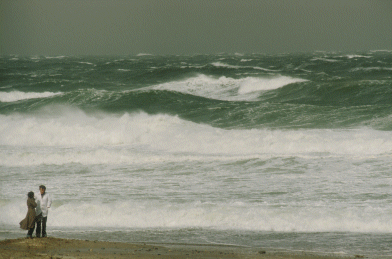
MIKE 21 SW includes a new generation spectral wind-wave model based on unstructured meshes. The model simulates the growth, decay and transformation of wind-generated waves and swell in offshore and coastal areas.
MIKE 21 SW is a state-of-the-art numerical tool for prediction and
analysis of wave climates in offshore and coastal areas
MIKE 21 SW includes two different formulations:
· Directional decoupled parametric formulation
· Fully spectral formulation
The directional decoupled parametric formulation is based on a parameterization of the wave action conservation equation. The parameterization is made in the frequency domain by introducing the zeroth and first moment of the wave action spectrum as dependent variables following Holthuijsen (1989). A similar approximation was used in the old MIKE 21 NSW Nearshore Spectral Wind-Wave Module.
The fully spectral formulation is based on the wave action conservation equation, as described in e.g. Komen et al. (1994) and Young (1999), where the directional-frequency wave action spectrum is the dependent variable.
The basic conservation equations are formulated in either Cartesian co-ordinates for small-scale applications and polar spherical co-ordinates for large-scale applications.
MIKE 21 SW includes the following physical phenomena:
· Wave growth by action of wind
· Non-linear wave-wave interaction
· Dissipation due to white-capping
· Dissipation due to bottom friction
· Dissipation due to depth-induced wave breaking
· Refraction and shoaling due to depth variations
· Wave-current interaction
· Effect of time-varying water depth and flooding and drying
The discretization of the governing equation in geographical and spectral space is performed using cell-centered finite volume method. In the geographical domain, an unstructured mesh technique is used. The time integration is performed using a fractional step approach where a multi-sequence explicit method is applied for the propagation of wave action.
Application Areas
MIKE 21 SW is used for the assessment of wave climates in offshore and coastal areas - in hindcast and forecast mode.
A major application area is the design of offshore, coastal and port structures where accurate assessment of wave loads is of utmost importance to the safe and economic design of these structures. Measured data is often not available during periods long enough to allow for the establishment of sufficiently accurate estimates of extreme sea states. In this case, the measured data can then be supplemented with hindcast data through the simulation of wave conditions during historical storms using MIKE 21 SW.
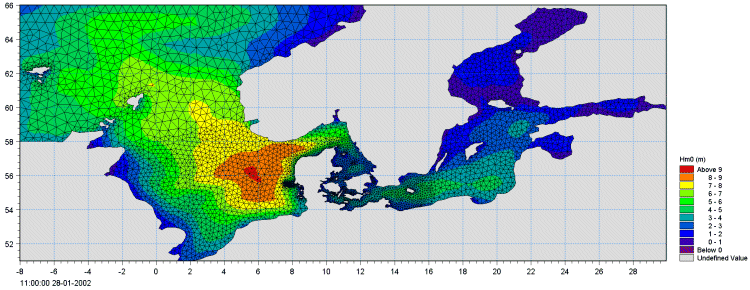
MIKE 21 SW is particularly applicable for simultaneous wave prediction and analysis on regional scale (like the North Sea, see figure below) and local scale (west coast of Jutland, Denmark). Coarse spatial and temporal resolution is used for the regional part of the mesh and a high-resolution boundary- and depth-adaptive mesh is describing the shallow water environment at the coastline.
MIKE 21 SW is also used in connection with the calculation of the sediment transport, which for a large part is determined by wave conditions and associated wave-induced currents. The wave-induced current is generated by the gradients in radiation stresses that occur in the surf zone. MIKE 21 SW can be used to calculate the wave conditions and associated radiation stresses. Subsequently the wave-induced flow is calculated using MIKE 21 Flow Model FM.
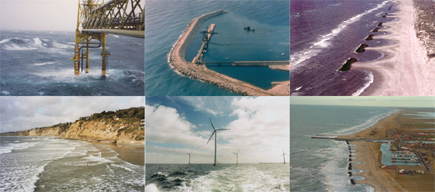
Illustration of typical application areas
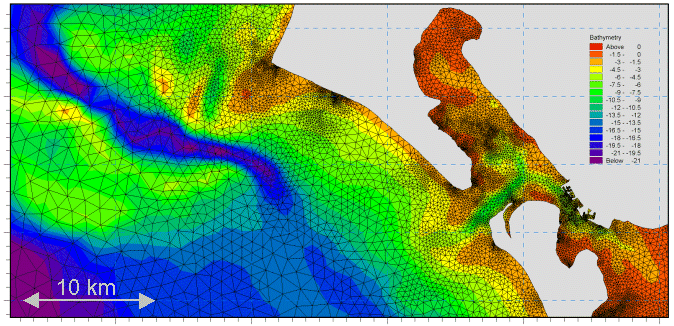
Example of a computational mesh used for transformation of offshore wave statistics using the directionally decoupled parametric formulation
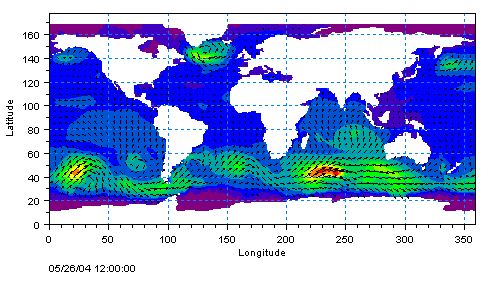
MIKE 21 SW is also applied on global scale as illustrated in the figure below.
Computational Features
The main features of MIKE 21 SW are as follows:
· Fully spectral and directionally decoupled parametric formulations
· Source functions based on state-of-the-art 3rd generation formulations
· Instationary and quasi-stationary solutions
· Optimal degree of flexibility in describing bathymetry and ambient flow conditions using depth-adaptive and boundary-fitted unstructured mesh
· Effects of ice coverage
· Coupling with hydrodynamic flow model for modelling of wave-current interaction and time-varying water depth
· Flooding and drying in connection with varying water levels
· Cell-centered finite volume technique
· Time integration using a fractional step approach and an efficient multi-sequence method
· Extensive range of model output parameters (wave, swell, air-sea interaction parameters, radiation stress tensor, spectra, etc.)
