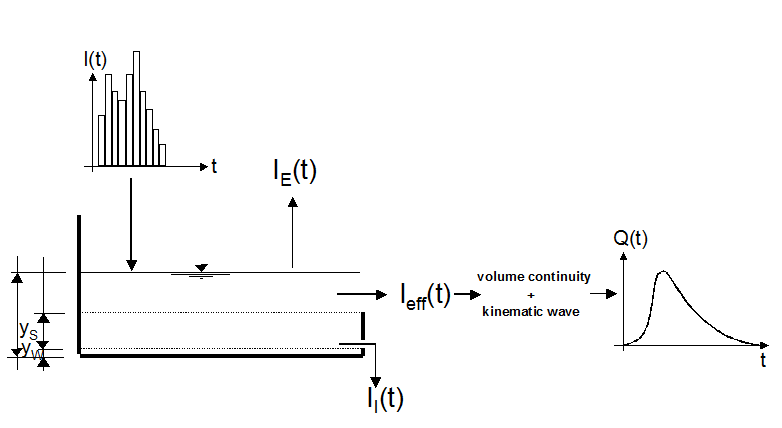
The concept of this surface rainfall-runoff model is founded on the kinematic wave computation. The surface runoff is computed as flow in an open channel, taking into account the gravitational and friction forces only. The amount that runs off is controlled by the various hydrological losses and the size of the actually contributing area.
The shape of the runoff hydrograph is controlled by the catchment parameters length, slope and roughness of the catchment surface. These parameters form a base for the kinematic wave computation using the Manning equation.
Infiltration to groundwater is calculated using a modified Horton equation.
The catchment is divided into five sub-catchments that have different permeability properties of the surface.
The five surface types are:
|
Permeability |
Surface type |
|---|---|
|
Impervious |
Steep Flat |
|
Pervious |
Small Medium Large |
Only relevant processes are modelled on each surface type. The model applies different hydrological parameters for each of the surface types. The total runoff is computed as the sum of these sub-catchments.
This tab contains the parameters defining the geometry and the hydrological characteristics of the catchment in which the Kinematic wave runoff model is implemented.
The parameters defined globally in the catchments are:
Length. The length parameter is defined by the catchment shape, as the flow channel. The model assumes a prismatic flow channel with rectangular cross section. The channel bottom width is computed from catchment area and length. The default value is 10 m.
Slope. It is the average slope of the catchment surface, used for the runoff computation according to Manning equation. The default value is 1.
The following parameters are defined for all the five different types of sub-catchments:
· Impervious area
· Steep
· Flat
· Pervious area
· Low impermeability
· Medium impermeability
· High impermeability
Contributing areas. Percentage that represents the fraction of the catchment surface belonging to each surface types. The default value depends on the surface type (see Table 7.3).
Manning’s M. The Manning’s number [m1/3 s-1] describes the roughness of the catchment surface, used in hydraulic routing of the runoff (Manning's formula). The default values depend on the catchment surface category (see Table 7.3).
Wetting loss. This loss [m] accounts for wetting of the catchment surface. The default value for all surface types is 5.00E10-5 m.
Storage loss. This loss [m] defines the precipitation depth required for filling the depressions on the catchment surface prior to occurrence of runoff. It is not defined for Steep impervious areas. The default value depends on the surface type (see Table 7.3)
The parameters of Horton’s equations must be defined for Pervious area surface types only:
Horton’s infiltration capacity – Maximum. This parameter, also called start infiltration rate, defines the maximum rate of infiltration (Horton) [m/s] for the specific surface type. The default value depends on the surface type (see Table 7.3).
Horton’s infiltration capacity – Minimum. This parameter, also known as end infiltration rate defines the minimum rate of infiltration (Horton) [m/s] for the specific surface type. The default value depends on the surface type (see Table 7.3).
Horton’s exponent – Wet condition. This time factor “characteristic soil parameter” [s-1] determines the dynamics of the infiltration capacity rate reduction over time during wet period. The actual infiltration capacity is made dependent of time since the rainfall start only. The default value depends on the surface type (see Table 7.3).
Horton’s exponent – Dry condition. This time factor [s-1] is used in the “inverse Horton's equation” and it defines the rate of the soil infiltration capacity recovery after a rainfall, i.e. in a drying period. The default value depends on the surface type (see Table 7.3)..
The Additional urban parameter tab allows adding to the catchment runoff extra discharge inputs and outputs, such as a constant baseflow, inflow based on the population living in the area, evaporation losses and snowmelt additional input.
Additional inflows
Constant flow. Constant (base-) flow which is being added to the runoff of the catchment throughout the entire simulation. If more than one constant inflow source is present in the catchment, their contributes should be summed up and entered here.
Load base on inhabitants. Number of person equivalents (PE). The additional inflow is generated only if this field is larger than 0. In that case the inhabitant load time series field becomes active in the Time series dialogue, where you should enter the inflow time series per inhabitant. This will be multiplied by PE to generate the inflow to the system.
Additional rainfall-runoff parameters
· Include evaporation. If this checkbox is selected, evaporation is included in the model. The evaporation time series file is specified in the Time series page.
· Include snow melt. If this checkbox is selected, snow melt is included in the model. The temperature time series file is specified in the Time series page.
· Degree-day coefficient. This value defines the rate of snow melting when temperature exceeds zero degrees Celsius.
In this section the input time series of the Kinematic wave rainfall-runoff model are entered. Depending on which processes are included in the model, these are:
· Rainfall. This time series represents the average catchment rainfall. The time interval between values may vary through the input series. The rainfall specified at a given time should be the rainfall volume accumulated since the previous value.
· Evaporation. The potential evaporation is typically given as monthly values. Like rainfall, the time for each potential evaporation value should be the accumulated volume at the end of the period it represents. The monthly potential evaporation in June should be dated 30 June or 1 July.
· Temperature. A time series of temperature, usually mean daily values, is required only if snow melt calculations are included in the simulations.
Weighted time series may be used by enabling ‘Use weighted time series’. This adds a new tab ‘TS weighted rainfall/evaporation’ where time series, their corresponding weights and distribution in time may be defined (see ‘Weighted time series’ previous in this section).
The model computations are based on the volume continuity and the kinematic wave equations.
The first step is the calculation of the snow storage if relevant, then the effective precipitation intensity. The effective precipitation intensity is the precipitation which contributes to the surface runoff, i.e. when the losses have been taken into account (evaporation, infiltration...).
Next, the hydraulic routing based on the kinematic wave formula (Manning) and volume continuity is applied. The sketch with schematics of the model computation is shown in Figure 7.5.
Figure 7.5 The simulated processes in Kinematic wave surface runoff model
Snow storage computation
Snow can accumulate when the temperature is inferior or equal to zero degrees Celsius. During warmer periods, when temperature exceeds zero degrees Celsius, the snow storage melts at a rate given by the snow melt coefficient. The snow storage computation will be performed only if a temperature time series is provided for the catchment.
During storing periods, or the snow will accumulate without limit. If the temperature is below zero degrees Celsius, it is assumed that the entire rainfall will be stored as snow.
During melting periods, or T>0°C the snow will melt and therefore contributes to the surface runoff at rate given by the snow melt coefficient.
The snow module is the first process occurring after rainfall, therefore all others losses will be computed afterwards.
Effective precipitation computation
The simulated hydrologic processes account for various losses calculated - evaporation, wetting, infiltration and surface storage - according to the conventions and equations presented below. The remaining precipitation is called effective precipitation, defined generally as:

Where:
|
|
Actual precipitation at time t |
|
|
Evaporation loss at time t. It should be noted that the evaporation loss for the catchment is accounted only if an evaporation time series in provided |
|
|
Wetting loss at time t |
|
|
Infiltration loss at time t |
|
|
Surface Storage loss at time t |
The individual terms in the loss equation are fundamentally different, as some terms are continuous where others are discontinuous. If the calculated loss is negative, it is set to zero. The losses have a dimension of velocity [LT-1].
The actual precipitation, I(t), is assumed to be uniformly distributed over the individual catchments. Otherwise, it may vary as a random time function.
The evaporation, IE(t), is a continuous loss that is normally of less significance for single event simulations. However, on a long-term basis, evaporation accounts for a significant part of hydrological losses. If included in the computation, the evaporation is the first part subtracted from the actual precipitation, according to the following:

Where:
|
|
Actual precipitation at time t |
|
|
Evaporation loss at time t |
|
|
Potential evaporation at time t |
|
|
Accumulated depth at time t |
If the actual evaporation is not explicitly specified in the simulation (i.e. Evaporation process activated – see INI file parameters – and evaporation time series specified), only a decay rate will be applied during dry periods.
The wetting, IW(t), is a discontinuous loss. When the precipitation starts, a part of the precipitation is used for wetting of the surface if the surface is initially dry. The model assumes that the precipitation remaining after subtraction of the evaporation loss is used for wetting of the catchment surface. When the surface is wet, the wetting loss, IW, is set to zero. This is summarised in the following expression:

Where:
|
|
Actual precipitation at time t |
|
|
Evaporation loss at time t |
|
|
Wetting loss at time t |
|
|
Wetting depth |
|
|
Accumulated depth at time t |
The infiltration, II(t), is the water loss to the lower storage caused by the porosity of the catchment surface. It is assumed that the infiltration starts when the wetting of the surface has been completed. The infiltration loss is calculated according to the following relation:

Where:
|
|
Infiltration loss at time t |
|
|
Horton’s infiltration at time t |
|
|
Wetting depth |
|
|
Accumulated depth at time t |
The infiltration is a complex phenomenon, dependent on the soil porosity, moisture content, groundwater level, surface conditions, storage capacity, etc. The model calculates the infiltration loss capacity using the well-known Horton's equation, per default in its original form:

Where:
|
|
Infiltration loss calculated according to Horton |
|
|
Maximum infiltration capacity (after a long dry period) |
|
|
Minimum infiltration capacity (at full saturation) |
|
t |
Time since the start of the storm |
|
ka |
Time factor (characteristic soil parameter) for wetting conditions |
The surface storage, IS(t), is the loss due to filling the depressions and holes in the terrain. The model begins with the surface storage calculation after the wetting process is completed. The surface storage is filled only if the current infiltration rate is smaller than the actual precipitation intensity reduced by evaporation. The actual surface storage loss is calculated according to the following:

Where:
|
|
Precipitation intensity at time t |
|
|
Surface storage loss at time t |
|
|
Infiltration loss at time t |
|
|
Wetting loss at time t |
|
|
Evaporation loss at time t |
|
|
Wetting depth |
|
|
Surface storage depth |
|
|
Accumulated depth at time t |
Surface Runoff routing computation
The runoff starts when the effective precipitation intensity is larger than zero. The hydraulic process is described with the kinematic wave equations for the entire surface at once. This description assumes uniform flow conditions on the catchment surface, i.e. equal water depth over the entire surface of certain category.
This type of runoff model is also called a non-linear reservoir model.
The surface runoff at time t is calculated as:

Where:
|
M |
Manning’s number |
|
B |
Flow channel width, computed as: |
|
I |
Surface slope |
|
|
Runoff depth at time t |
The depth yR(t) is determined from the continuity equation:
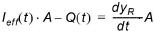
Where:
|
Ieff |
Effective precipitation |
|
A |
Contributing catchment surface area |
|
dt |
Time step |
|
|
Change in runoff depth |
Hydrological losses depending on surface type
The Kinematic Waves Surface Runoff Model distinguishes between up to 5 different catchment surface types. This is practically handled by the model so that the individual catchment is split into up to five sub-catchments, each with the area according to the specified percentages for specific surface categories.
For each surface type, only relevant processes are simulated. An overview of the processes associated with different surface types is shown in Table 7.8..
The model treats every area with different surface category as a sub-catchment, and the runoff computations are performed individually. The total runoff from the entire catchment is obtained then as a sum of runoffs from up to five different sub-catchments.
Definition of the sub-catchment geometry
The length and width for each sub-catchment (sub-area) are calculated so that the length/width ratio for each sub-area is kept equal to the length/width ratio of the corresponding catchment. Based on the information for the whole catchment and the principle of constant length/width ratio, equivalent values of the runoff width and length are computed for all sub-areas, as illustrated in the example below (Figure 7.6).
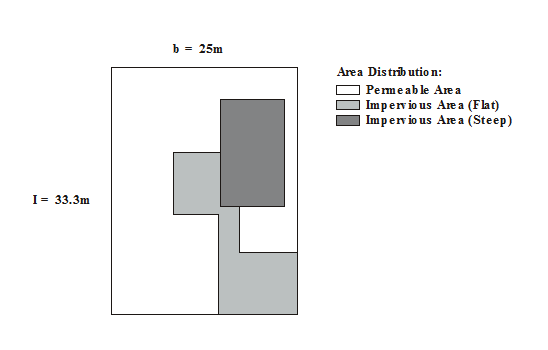
Figure 7.6 Sub-catchments with total area = 833 m2
The ratio between the catchment length and width in the given example corresponds to 1.33. 15% of the total area is impervious roof surface corresponding to 125 m2. Hence the runoff length is 12.9 m and the runoff width is 9.7 m for this surface type, as 12.9 * 9.7 = 125 and 9.7 * 1.33 = 12.9.
Multiple-Event Simulations
If the Kinematic wave surface runoff model is used for a continuous simulation of multiple rainfall events, a special solution has been applied for the simulation of dry periods between the consecutive events. The solution accounts for the following phenomena:
Recovery of the soil infiltration capacity
According to Horton equations, the soil infiltration capacity is getting reduced as the soil gets more saturated by rain. In dry periods, an inverse process occurs, with gradual recovery of the infiltration capacity. Computation of both processes is detailed in Section 7.4.3.
As a consequence of wet and dry period alternation in a multiple event simulation, the model alternates between the two computation modes.
Switching to the “dry” mode is triggered by the exhaustion of all water available for infiltration. Consecutively, switch to the “wet” mode at the start of a new rain event.
Recovery of the initial loss capacity during dry intervals
The occurrence of the initial loss at the beginning of each simulated event is modelled in accordance with reality. During dry periods, the initial loss capacity will be recovered if no evaporation time series has been provided.


