In the Time-Area (T-A) surface rainfall-runoff method, the runoff is controlled by the initial loss, size of the contributing area and by a continuous hydrological loss. Moreover a snow storage may be added to the computation.
The shape of the runoff hydrograph is controlled by the concentration time and by the time-area (T-A) curve. These two parameters represent a conceptual description of the catchment reaction speed and the catchment shape.
Some of the model specific data for the T-A model are entered in the Time-Area tab.
· Impervious area. This parameter represents the fraction [%] of the catchment area considered to contribute to the runoff.
· Time of concentration. The time of concentration parameter defines the time required for the flow of water from the most distant part of the catchment to the point of outflow. The default value is 420 seconds.
· Reduction factor. This is a hydrological runoff reduction factor accounting for water losses caused by e.g. evapotranspiration, imperfect imperviousness, etc. on the contributing area. The default value is 0.90.
· Initial losses. The initial losses define the precipitation depth required to start the surface runoff. This is a one-off loss, comprising the wetting and filling of catchment depressions. The default value is 0.6 mm.
· Time-area curve. This curve accounts for the shape of the catchment layout, and determines the choice of the available T-A curve to be used in the computation.
Three predefined types of the T-A curves are available:
1. Rectangular catchment
2. Divergent catchment
3. Convergent catchment
The values of the time and area associated with each curve type can be found in the following table
.
|
Curve type 1 |
Curve type 2 |
Curve type 3 |
|||
|---|---|---|---|---|---|
|
Time [-] |
Area [-] |
Time [-] |
Area [-] |
Time [-] |
Area [-] |
|
0 1 |
0 1 |
0 0.1 0.2 0.3 0.4 0.5 0.6 0.7 0.8 0.9 1 |
0 0.12 0.28 0.47 0.61 0.72 0.8 0.87 0.93 0.98 1 |
0 0.1 0.2 0.3 0.4 0.5 0.6 0.7 0.8 0.9 1 |
0 0.01 0.04 0.08 0.15 0.24 0.35 0.47 0.62 0.8 1 |
The Additional urban parameter tab allows adding to the catchment runoff extra discharge inputs and outputs, such as a constant baseflow, inflow based on the population living in the area, evaporation losses and snowmelt additional input.
Additional inflows
Constant flow. Constant (base-) flow which is being added to the runoff of the catchment throughout the entire simulation. If more than one constant inflow source is present in the catchment, their contributions should be summed up and entered here.
Load based on inhabitants. Number of person equivalents (PE). The additional inflow is generated only if this field is larger than 0. In that case the inhabitant load time series field becomes active in the Time series dialogue, where you should enter the inflow time series per inhabitant. This will be multiplied by PE to generate the inflow to the system.
Additional rainfall-runoff parameters
· Include evaporation. If this checkbox is selected, evaporation is included in the model. The evaporation time series file is specified in the Time series page.
· Include snow melt. If this checkbox is selected, snow melt is included in the model. The temperature time series file is specified in the Time series page.
· Degree-day coefficient. This value defines the rate of snow melting when temperature exceeds zero degrees Celsius.
In this section the input time series of the Time-Area rainfall-runoff model are entered. Depending on which processes are included in the model, these are:
· Rainfall. This time series represents the average catchment rainfall. The time interval between values may vary through the input series. The rainfall specified at a given time should be the rainfall volume accumulated since the previous value.
· Evaporation. The potential evaporation is typically given as monthly values. Like rainfall, the time for each potential evaporation value should be the accumulated volume at the end of the period it represents. The monthly potential evaporation in June should be dated 30 June or 1 July.
· Temperature. A time series of temperature, usually mean daily values, is required only if snow melt calculations are included in the simulations.
Weighted time series may be used by enabling ‘Use weighted time series’. This adds a new tab ‘TS weighted rainfall/evaporation’ where time series, their corresponding weights and distribution in time may be defined (see ‘Weighted time series’ previous in this section).
Snow storage computation
Snow can accumulate when the temperature is inferior or equal to zero degrees Celsius. During warmer periods, when temperature exceeds zero degrees Celsius, the snow storage melts at a rate given by the degree-day coefficient. The snow storage computation will be performed only if a temperature time series is provided for the catchment.
During storing periods, the snow will accumulate without limit. If the temperature is below zero degrees Celsius, it is assumed that the entire rainfall will be stored as snow.
During melting periods, the snow will melt and therefore contributes to the surface runoff at rate given by the degree-day coefficient.
The snow module is the first process occurring after rainfall, therefore all other losses will be computed afterwards.
Effective precipitation computation
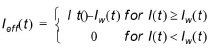
The simulated hydrological processes account for specific losses. The runoff starts after the rain depth has exceeded the specified initial loss for the catchment. The remaining precipitation is called effective precipitation, defined generally as:
The actual precipitation, I(t), is assumed to be uniformly distributed over the individual catchments. Otherwise, it may vary as a random time function.
The wetting, Iw(t), is a discontinuous loss, also called initial loss. When the precipitation starts, a part of the precipitation is used for wetting of the surface if the surface is initially dry. When the surface is wet, the wetting loss, Iw, is set to zero. This is summarised in the following expression:

Surface runoff routing computation
The continuous runoff process is discretised in time by the computational time step Dt. The assumption of the constant runoff velocity implies the spatial discretisation of the catchment surface to a number of cells in a form of concentric circles with a centre point at the point of outflow. The number of cells being equals to:

Where:
tc : Concentration time [s]
Dt : simulation time step [s]
The 1D engine calculates the area of each cell on the basis of the specified time-area curve or coefficient. The total area of all cells is equal to the specified impervious area.
A time-area curve characterises the shape of the catchment, relating the flow time i.e. concentric distance from the outflow point and the corresponding catchment sub-area. Irregularly shaped catchments can be more precisely described by the user-specified T-A curves or coefficient.
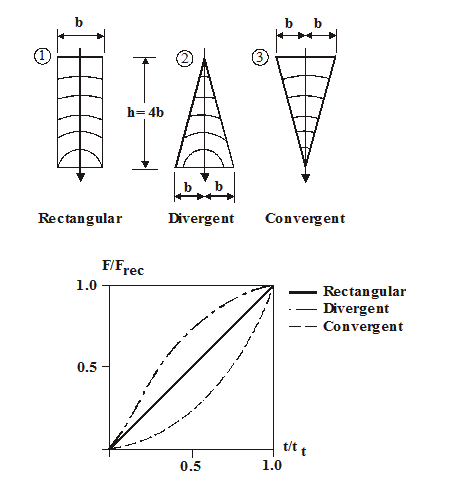
Figure 7.4 The three predefined time/area curves available
The runoff stops when the accumulated rain depth on the whole catchment surface regresses below the specified initial loss for the catchment.
At every time step after the start of the runoff, the accumulated volume from a certain cell is moved to the downstream direction. Thus, the actual volume in the cell is calculated as a continuity balance between the inflow from the upstream cell, the current rainfall (multiplied with the cell area) and the outflow to the downstream cell. The outflow from the most downstream cell is actually the resulting surface runoff hydrograph.
To account for the specified hydrological reduction, the runoff from the impervious surface is reduced by the catchments hydrological reduction factor.
If the Time-Area runoff model is used for a continuous simulation of multiple rainfall, a special solution can be applied for the simulation of dry periods between the consecutive events. The solution accounts for the loss of water caused by drying out of the initial loss (representing wetting and surface storage), i.e. allowing the occurrence of the initial loss at the beginning of each simulated event, in accordance with reality.
In this context, start of a dry period is defined if two conditions are fulfilled simultaneously:
· No rainfall: all connected rain gauges show no rain.
· No runoff: the runoff has fallen to zero from all catchments included in the simulation.
At the start of a dry period, the initial loss storage would be fully or partially filled up, the latter being the only case for small events of the total depth smaller than the initial loss storage depth. Recovery of the initial loss capacity, i.e. the process of surface drying is simulated as a constant “decay” rate, which replaces the actual evaporation.
The evaporation rate can be given as initial loss rate or as an evaporation time series. If the actual evaporation is not explicitly specified in the simulation (i.e. evaporation process activated and evaporation time series specified), only a decay rate will be applied during dry periods.
The recovery process is only activated during dry periods, i.e. the evaporative action during rain events is neglected.
