
Under the General tab the following types of information may be specified.
Location
ID. String identification of the pump. ID will be used in structure results and hence makes it easier to identify a specific structure if setup contains many structures, or if multiple structures are defined at the same location.
Branch name. The Branch name is automatically registered where the pump is located.
Chainage. Chainage at which the pump is located.
Type. The location type may be defined as Regular, Side Structure or Side Structure with Reservoir. See Structure types definition (p. 114) for details.
Pump data
Pump type. The pump type is determined by the way its pump rate or discharge is defined:
· Fixed discharge: Pump discharge is fixed and independent of the local water head except for the start/stop control.
· Tabulated: Pump discharge is controlled by a specified Q/dH relationship and the water level difference (dH). To add a Q/dH relationship click the
· button and a new row will appear in the table.
The discharge is determined through interpolated look up in the table. The dH used for the look-up is generally calculated as the difference between downstream and upstream water level. However, if an outlet level has been defined then the effective downstream water level used in the dH calculation is the maximum of Outlet level and the downstream water level.
Note that extrapolation is not allowed. It is therefore recommended to add limit points to the Q-dH -curve. See Figure 6.30.
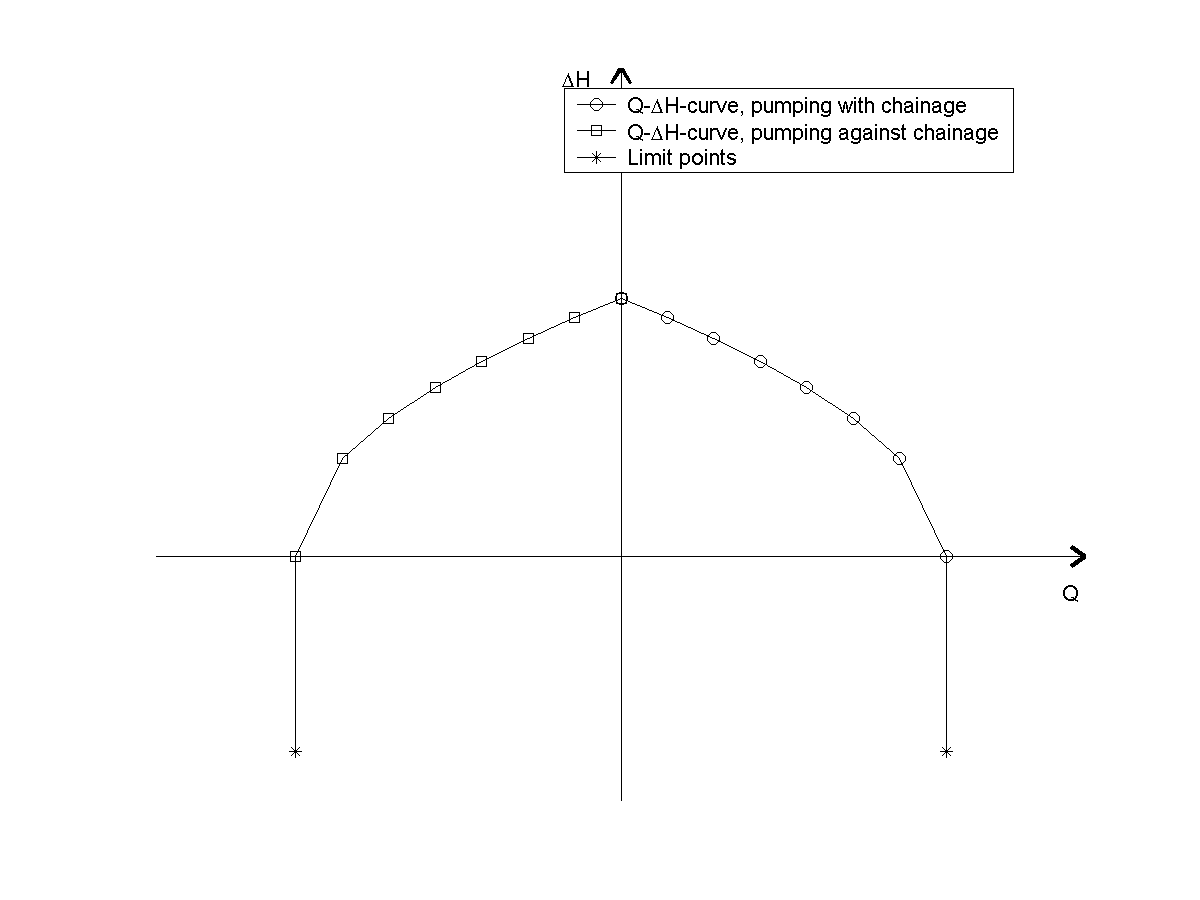
Figure 6.30 Q-dH curves for pumps

Note that a positive discharge Q is always interpreted as the pump pumping from upstream to downstream (i.e. from higher lying areas to a lower lying areas) disregarding any chainage conventions. Typically, this is from smaller chainage to higher chainage. If a negative flow direction is selected for the branch containing the structure, positive discharge is still interpreted as pumping from upstream to downstream areas (which in this situation means pumping from higher chainages to smaller chainages).
Attributes
Start level: The pump will be activated when the upstream water level exceeds the Start level.
Stop level: Water level at which the pump starts closing down.
Startup period: Period for changing pump discharge from zero to full. The pump discharge is changed linearly in time.
Close down period: Period for changing pump discharge from full to zero. The pump discharge is changed linearly in time.
Outlet level: The outlet level is used when calculating the dH value at the location of the pump. If specified with a value >0 the dH will be calculated as the difference of upstream water level and the maximum of downstream water level and the outlet level.
